
Engineering · Cryptography · Open standards
Don't build another identity provider.
Build a world that doesn't need one.
SAUPHI is an open protocol initiative exploring how digital identity can be designed around individual sovereignty, selective disclosure, decentralized trust and independent recovery.
We are not building another authentication platform.
We are working toward an interoperable foundation that independent developers, organizations and individuals can implement without depending on a central operator.
Architecture and research phase.
Principles before implementation.
Assume compromise
Every device, credential, application and institution must be considered potentially compromisable.
Minimize trust
Participants should not be required to trust more entities than necessary for a specific interaction.
Minimize disclosure
Collect, transmit and retain only the information genuinely required.
Isolate failures
A compromised relationship should not automatically compromise unrelated identity contexts.
Avoid universal secrets
No single universal master key should provide unrestricted control over an individual’s entire digital existence.
Design recovery from the beginning
Recovery must be a foundational architectural requirement, not an afterthought.
Prefer established standards
Evaluate existing, independently reviewed technologies before inventing new mechanisms.
Make security verifiable
Security claims must be supported by explicit assumptions, threat models, reproducible tests and independent review.
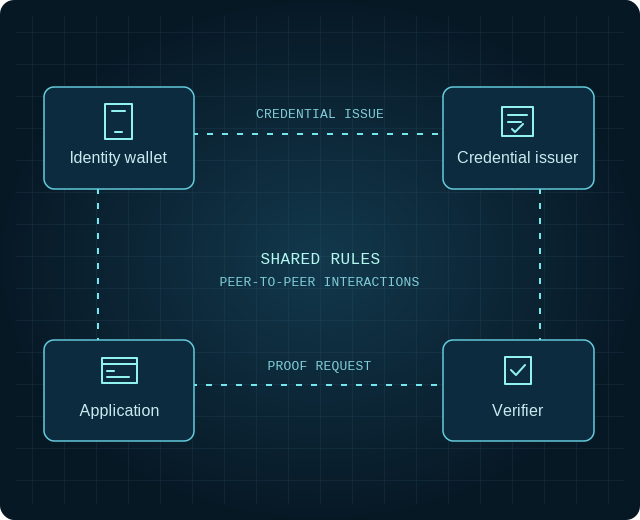
Independent components. Shared rules.
- Credential issuers → Credential holdersIssue credentials to individuals using identity wallets they control.
- Credential holders → Service providers and verifiersPresent only what the interaction requires, using separate identity contexts for different relationships.
- Verifiers → Trust and credential status mechanismsEvaluate issuer trust and credential status where applicable, with privacy safeguards subject to research.
- Individuals ↔ Independent recovery participantsExplore recovery as a separate trust boundary, with no mandatory recovery operator.
Independent implementations would follow shared protocol rules. Each participant retains its own responsibilities and trust boundary.
The problems worth solving.
These areas are under exploration or planned for research. Technology selections are pending.

Identity and identifiers
Explore pairwise identifiers, pseudonymous relationships and separation between identity contexts.

Credentials and proofs
Explore verifiable credentials, selective disclosure, proof composition and zero-knowledge techniques.

Cryptography and key management
Evaluate cryptographic primitives, key separation, rotation, secure storage and cryptographic agility.

Trust models
Define how participants establish confidence in issuers, credentials and verification results without relying on a mandatory central authority.

Recovery and continuity
Explore independent recovery, device migration, credential replacement and resilience against permanent identity loss.

Revocation and credential status
Investigate privacy-preserving methods of determining whether credentials remain valid.

Privacy and metadata
Study correlation risks, network metadata, timing information, identifier reuse and unintended information leakage.

Interoperability
Define how independently developed implementations can communicate, validate credentials and exchange proofs consistently.

Protocol governance
Explore transparent mechanisms for technical proposals, versioning, compatibility and protocol evolution.

Abuse resistance
Study impersonation, fraud, coercion, replay attacks, malicious issuers and other adversarial behavior without introducing unnecessary universal surveillance.
Request a proof. Not a dossier.
Conceptual API examples. No SDK, API, wire format or protocol specification is currently available.
These TypeScript-style examples are illustrative pseudocode. The eventual syntax and behavior are open design questions.
const request = {
  purpose: "age-verification",
  requirement: {
    attribute: "age",
    operator: ">=",
    value: 18
  },
  disclosure: "minimum-required"
};const result = {
requirementSatisfied: true,
disclosedAttributes: []
};const relationship = {
context: "merchant.example",
identifier: "relationship-specific",
scope: ["purchase"],
expires: "transaction-complete"
};- Service requests a proof. It specifies the purpose and evidence it needs.
- Identity tool evaluates the request. It identifies what disclosure would involve.
- Identity tool presents a limited proof. Presentation follows approval.
- Verifier evaluates the proof. Technical verification is separate from the individual’s consent.
Trust nothing blindly. Including SAUPHI.
A protocol intended to protect human identity must be designed for hostile environments. Research must consider:
- Compromised devices.
- Malicious applications.
- Credential theft.
- Compromised issuers.
- Colluding verifiers.
- Replay attacks.
- Metadata correlation.
- Recovery abuse.
- Coercion.
- Supply-chain compromise.
- Implementation vulnerabilities.
- Cryptographic obsolescence.
- Relationship ACompromise within this trust boundary
- Relationship BSeparate credentials and trust boundary
- Recovery contextSeparate recovery controls and trust boundary
The project intends to establish:
- Explicit security assumptions.
- Documented threat models.
- Reproducible security tests.
- Independent cryptographic review.
- Interoperability testing.
- Responsible vulnerability disclosure procedures.
A protocol should earn trust through evidence, not demand it through authority.
Build on what works. Challenge what doesn’t.
SAUPHI intends to evaluate existing open standards and established cryptographic research. Potential research references include:
- W3C Verifiable Credentials.
- Decentralized Identifiers.
- OpenID for Verifiable Credentials.
- Selective disclosure credential formats.
- Zero-knowledge proof systems.
- WebAuthn and FIDO standards.
- Modern cryptographic key-management approaches.
- Privacy-preserving credential status mechanisms.
These references identify areas for evaluation. Technology selections are pending. Blockchain is not assumed to be necessary. Personal information must not be placed on public or immutable ledgers.
The protocol’s foundational principles must guide technology selection, rather than technology selection determining its principles.
Everything needed to build independently.
Protocol specification
PlannedFormal definitions, requirements, message formats and interoperability rules.
Reference implementation
PlannedAn open implementation for experimentation, validation and interoperability testing.
Developer SDKs
PlannedLibraries for integrating independently developed applications.
Identity wallet reference tools
PlannedExperimental tools for credential management, proof generation and identity relationships.
Conformance test suite
PlannedReproducible tests for evaluating implementation compatibility.
Security test framework
PlannedAdversarial testing, documented attack scenarios and security regression tests.
Technical documentation
PlannedArchitecture documents, integration guides, examples and protocol references.
RFC process
PlannedA transparent mechanism for proposing, reviewing and evolving technical specifications.
Help define the protocol, not just implement it.
SAUPHI intends to welcome contributions from software engineers, protocol architects, cryptographers, security researchers, privacy engineers, distributed systems specialists, UX and accessibility designers, standards experts, and academic researchers.
Contributions can include challenging architectural assumptions, identifying security weaknesses, proposing alternatives and documenting limitations. Disagreement supported by evidence should be welcomed.
The formal contribution process and technical repositories are being prepared.
Developer commitments
These are foundational design commitments. Implementation and independent validation are still ahead.
- No mandatory central API.
- No proprietary identity gateway.
- No universal master identifier.
- No required commercial subscription.
- No protocol-mandated tracking.
- No personal information on public ledgers.
- No exclusive implementation rights.
- No blind trust.
The best infrastructure is the infrastructure nobody owns exclusively.
SAUPHI is not looking to become the next dominant identity platform.
It aims to establish an open foundation upon which independent implementations can coexist, compete, interoperate and evolve.
The protocol must serve humanity without requiring humanity to serve the protocol.
Build independently. Interoperate openly. Protect the individual.
One human. Many identities. No master.